Perianal Abscess Treatment in Nashik: Painful Swelling Near the Anus, Causes, Surgery & Recovery
By Dr. Sachin A. Jadhav, MS (Ayurveda – Surgery)
SUKHAM Anocare | Sukhayu Hospital, Canada Corner, Nashik
Medically reviewed patient education article | Updated: October 2026
Painful Swelling Near the Anus? It Could Be a Perianal Abscess
A painful lump near the anus is often mistaken for piles, a simple boil, or a minor skin infection. However, severe pain, swelling, and fever may indicate a perianal abscess, a condition that frequently requires prompt surgical drainage.
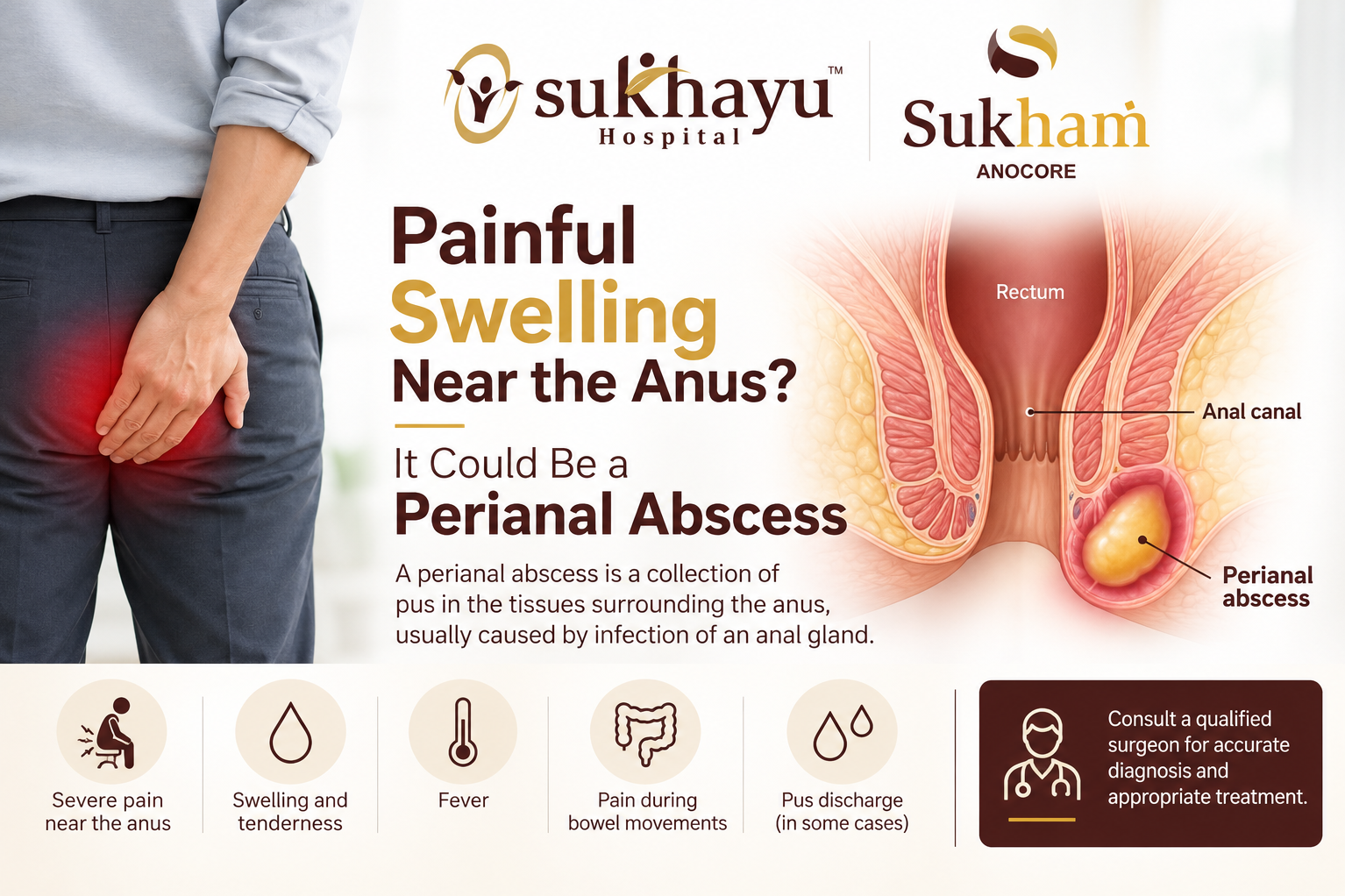
A perianal abscess is a collection of pus in the tissues surrounding the anus, usually caused by infection of an anal gland. Common symptoms include throbbing anal pain, swelling, tenderness, and sometimes fever.
If you are experiencing severe pain near the anus, particularly when sitting or passing stools, you should consult a qualified surgeon without delay.
At SUKHAM Anocare, Sukhayu Hospital, Nashik, we evaluate and manage anorectal conditions including perianal abscesses, anal fistulas, fissures, and haemorrhoids.
Patient Experience: 'I Thought It Was Just a Boil Near My Anus'
The following is a fictional, illustrative patient journey based on common clinical presentations. It is not an actual patient testimonial.
Rajesh, a 38-year-old office worker, noticed a small swelling near his anus.
Initially, he thought it was a harmless boil.
He continued working, hoping it would disappear.
But within three days, the pain became increasingly severe.
Sitting in his office chair was difficult. Walking caused discomfort. He could barely sleep because of the constant throbbing pain.
Eventually, he developed fever and increasing swelling.
Embarrassed to discuss the problem, he delayed seeking medical advice.
When he finally consulted a surgeon, clinical examination suggested a posterior perianal abscess.
He was surprised to learn that the problem was not ordinary piles.
The surgeon explained that an infected cavity containing pus had developed near the anal opening.
Following appropriate evaluation, incision and drainage were recommended.
After the procedure, the pressure-related pain improved significantly.
During follow-up, Rajesh learned that continued observation was important because some patients develop an anal fistula after an abscess.
His experience illustrates why persistent anal pain and swelling should not be ignored.
What Is a Perianal Abscess?
A perianal abscess is a localised collection of infected fluid or pus in the soft tissues surrounding the anus.
Most cases develop when small glands located inside the anal canal become infected.
As infection progresses, pus accumulates and causes increasing pressure, swelling, and pain.
Perianal abscesses may be superficial or extend into deeper tissues.
Deep abscesses can sometimes cause severe pain without an obvious external swelling.
Common Symptoms of a Perianal Abscess
Symptoms may include:
- Severe, continuous, throbbing pain near the anus
- Painful swelling or a lump beside the anal opening
- Difficulty sitting or walking comfortably
- Pain during bowel movements
- Redness, warmth, and tenderness
- Fever or chills
- Pus discharge from the affected area
- Increasing pain despite taking painkillers
Important: Severe anal pain accompanied by fever or rapidly increasing swelling requires urgent medical assessment.
Is a Perianal Abscess the Same as Piles?
No. A perianal abscess and haemorrhoids (piles) are different conditions.
Piles are enlarged or displaced haemorrhoidal cushions that may cause bleeding, prolapse, itching, or discomfort.
A perianal abscess is an infected collection of pus that typically produces severe pain and tenderness.
A thrombosed external haemorrhoid can also produce a very painful lump and may resemble an abscess.
Therefore, examination by a surgeon is essential for an accurate diagnosis.
Can a Perianal Abscess Heal Without Surgery?
A significant perianal abscess generally requires surgical drainage.
Although a small abscess may occasionally drain spontaneously, this does not guarantee that the infection has resolved.
Antibiotics alone are usually insufficient to treat an established abscess because the infected cavity often needs to be opened and drained.
Antibiotics may be prescribed when clinically indicated, especially in patients with cellulitis, systemic infection, diabetes, or compromised immunity.
Patients should not attempt to squeeze, puncture, or drain an anal abscess at home.
How Is Perianal Abscess Surgery Performed?
The standard treatment is called incision and drainage (I&D).
The surgeon examines the affected region and determines the location and extent of the abscess.
Depending on its size, depth, and clinical circumstances, drainage may be performed under local, regional, or general anaesthesia.
During the procedure, an opening is made to drain the pus, and the cavity is assessed.
The wound is usually managed to permit continued drainage and healing.
Deep or complex abscesses may require examination under anaesthesia, imaging, or more extensive surgical management.
The appropriate procedure depends on the individual patient's findings.
Perianal Abscess at the 6 O'Clock Position: What Does It Mean?
Surgeons sometimes describe the location of an anal abscess using a clock-face system.
In the standard anatomical orientation, the 6 o'clock position indicates the posterior aspect of the anus.
A painful swelling at this location may represent a superficial posterior perianal abscess.
However, some posterior abscesses involve the deep postanal space or extend to both sides of the anus, producing a horseshoe abscess.
These conditions require careful surgical assessment because the treatment differs from that of a simple superficial abscess.
Recovery After Perianal Abscess Drainage
Recovery depends on the size and depth of the abscess, the severity of infection, associated medical conditions, and wound healing.
Patients may experience substantial pain relief after drainage, although wound discomfort can continue during healing.
Postoperative care may include prescribed pain medication, wound hygiene, dressing changes when required, and regular follow-up.
Patients should seek reassessment if they experience persistent fever, increasing pain, worsening swelling, or recurrent discharge.
Some wounds heal over several weeks, particularly when the abscess is large or deep.
Can a Perianal Abscess Develop Into an Anal Fistula?
Yes.
An anal fistula is an abnormal tract connecting the anal canal to the skin around the anus.
A fistula may become apparent after a perianal abscess has drained or healed.
Signs suggesting a fistula include:
- Repeated swelling near the anus
- Persistent or intermittent pus discharge
- A small opening in the perianal skin
- Recurrent abscess formation
- Repeated episodes of pain and inflammation
Not every patient develops a fistula.
However, recurrence or persistent drainage warrants further evaluation.
Frequently Asked Questions About Perianal Abscess
1. What causes a painful lump near the anus?
Possible causes include a perianal abscess, thrombosed external haemorrhoid, infected skin cyst, or other inflammatory conditions. A painful lump associated with fever or increasing tenderness may indicate an abscess.
2. Is perianal abscess surgery painful?
The procedure is performed using appropriate anaesthesia. Some discomfort is expected afterward, but drainage often relieves the intense pressure-related pain caused by the abscess.
3. Can antibiotics cure a perianal abscess?
Antibiotics alone are generally not adequate for an established collection of pus. Most clinically significant perianal abscesses require drainage.
4. How long does it take to recover after perianal abscess surgery?
Pain often improves during the first few days, but complete wound healing may take several weeks. Recovery varies depending on the abscess and the patient's condition.
5. Can a perianal abscess come back?
Yes. Recurrence may occur, particularly when an underlying anal fistula or another contributing condition is present.
6. Can a perianal abscess become dangerous?
Yes. Untreated infection can spread into surrounding tissues and occasionally cause serious systemic infection. Patients with diabetes or weakened immunity may be at greater risk of complications.
7. Which doctor should I consult for a perianal abscess?
A general surgeon or colorectal surgeon experienced in anorectal conditions can evaluate and treat a suspected perianal abscess.
8. Where can I seek perianal abscess treatment in Nashik?
Patients experiencing anal pain, swelling, or suspected perianal abscess can seek surgical consultation at SUKHAM Anocare, Sukhayu Hospital, Canada Corner, Nashik.
Perianal Abscess and Anal Fistula Care at SUKHAM Anocare, Nashik
SUKHAM Anocare is a specialised anorectal care initiative at Sukhayu Hospital, Nashik.
The service focuses on the evaluation and management of conditions affecting the anus and rectum, including:
- Perianal abscess
- Anal fistula
- Anal fissure
- Haemorrhoids (piles)
- Recurrent anorectal infections
- Other anorectal disorders
Our clinical approach emphasises accurate diagnosis, appropriate treatment, pain management, patient privacy, and postoperative follow-up.
Consult for Painful Swelling Near the Anus in Nashik
Do not ignore severe anal pain, swelling, fever, or persistent discharge.
Timely evaluation can help identify the underlying condition and determine whether surgical drainage or other treatment is necessary.
SUKHAM Anocare – Sukhayu Hospital
Patil Lane No. 1, Canada Corner, Nashik, Maharashtra
Medical Author: Dr. Sachin A. Jadhav
MS (Ayurveda – Surgery)
Disclaimer: This article provides general medical information and does not replace clinical examination or personalised medical advice. The patient story is fictional and included for educational purposes.
Keywords