Anal Fissure Treatment in Nashik: Severe Pain During Stool, Fissure Surgery, Anoplasty and Recovery
Why does passing stool feel like passing broken glass? Understanding anal fissures and modern treatment options.
Medical Author: Dr. Sachin A. Jadhav, MS (Ayurveda – Surgery)
SUKHAM Anocare | Sukhayu Hospital, Canada Corner, Nashik
Medical Education Article | October 2026
Severe Pain During Bowel Movements? You May Have an Anal Fissure
Are you experiencing sharp, cutting, or burning pain while passing stools? Do you notice bright red blood on toilet paper? Does the pain continue for several minutes or even hours after visiting the toilet?
These symptoms may indicate an anal fissure, also called fissure-in-ano.
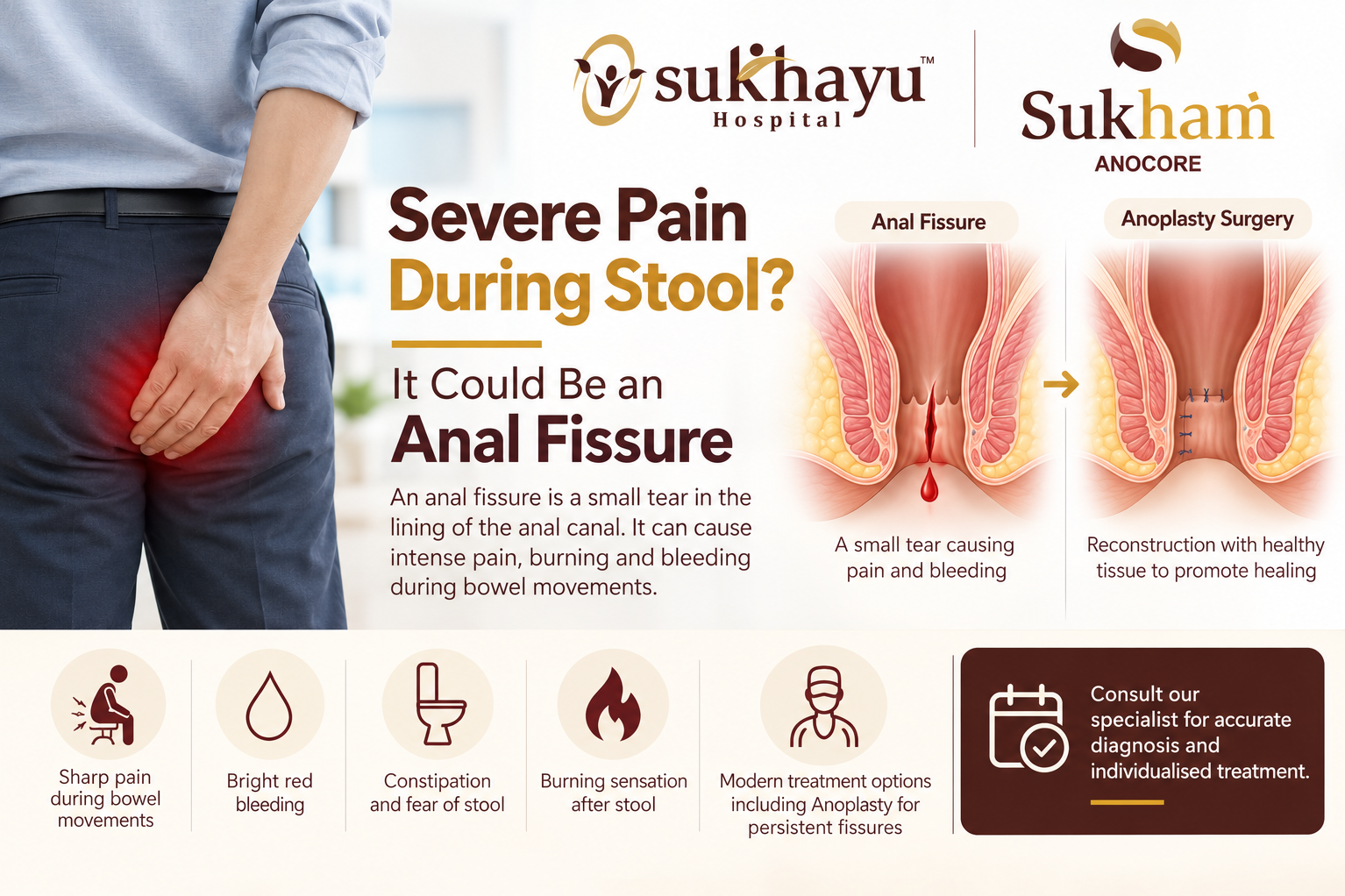
An anal fissure is a small tear in the delicate lining of the anal canal. Although the tear may be tiny, it can cause extremely severe pain.
Many patients mistake an anal fissure for piles and continue using haemorrhoid creams without obtaining a proper diagnosis.
The good news is that most acute anal fissures improve with appropriate medical treatment. Patients with persistent, chronic, or recurrent fissures may require additional treatment, including selected surgical procedures.
At SUKHAM Anocare, Sukhayu Hospital, Nashik, patients can receive surgical evaluation and individualised management for anal fissures and other anorectal conditions.
A Patient's Journey: 'I Was Afraid to Go to the Toilet'
The following is an illustrative patient story created for medical education. It does not represent an actual patient testimonial.
For 35-year-old Amit, a marketing professional from Nashik, every morning had become a painful experience.
His problem started with constipation.
One morning, while passing a particularly hard stool, he experienced a sudden, sharp pain near the anus.
He noticed a few drops of bright red blood.
Initially, he thought he had piles.
He purchased an over-the-counter cream and started taking painkillers.
However, the problem continued.
When a Simple Daily Activity Became Frightening
Over the next several weeks, Amit began experiencing severe pain during bowel movements.
The pain was sometimes so intense that he described it as feeling like broken glass passing through the anus.
Even after leaving the toilet, the burning sensation continued.
He started avoiding bowel movements because he feared the pain.
Unfortunately, this made his constipation worse.
His stools became harder, and each bowel movement aggravated the existing tear.
He found himself trapped in a painful cycle:
Constipation → Hard Stool → Anal Tear → Severe Pain → Fear of Defecation → Further Constipation
Eventually, Amit decided to consult a surgeon.
The Diagnosis: Fissure-in-Ano
During examination, the surgeon identified findings consistent with an anal fissure.
Amit learned that the condition was different from piles.
The surgeon explained that an anal fissure is a tear in the anal canal lining, commonly associated with hard stools, constipation, or excessive straining.
In some patients, increased anal sphincter tone and reduced blood supply to the affected area can contribute to persistent pain and delayed healing.
Amit was initially advised appropriate medical management, including stool regulation, dietary modification, warm sitz baths, and prescribed medication.
However, in this illustrative case, his symptoms persisted despite an adequate course of treatment, and the fissure developed chronic features.
When Surgery Became an Option
After reassessment, the surgeon discussed available treatment options, including continued medical management and surgical intervention.
The choice of surgery depended on the fissure's characteristics, sphincter function, previous treatment, and individual risk factors.
For selected patients with chronic fissures, fissurectomy with an advancement flap, sometimes described as fissure anoplasty, may be considered.
The surgeon explained that anoplasty is not necessary for every anal fissure and is not the routine treatment for a newly developed acute fissure.
Amit underwent the procedure selected for his condition.
During recovery, he followed instructions regarding wound care, bowel regulation, medication, and follow-up.
His pain gradually improved as healing progressed.
The Most Important Lesson
Amit realised that he had delayed treatment because of embarrassment and an incorrect assumption that all anal pain was caused by piles.
His experience highlights an important message:
Persistent pain during bowel movements should not be ignored. Early diagnosis can prevent prolonged suffering and help patients avoid unnecessary treatment delays.
What Is an Acute Anal Fissure?
An acute anal fissure is a recently developed tear in the lining of the anal canal, generally present for less than approximately six weeks.
It commonly develops after passage of hard stools or excessive straining.
Typical symptoms include severe pain during defecation, burning afterward, and small amounts of bright red bleeding.
Acute fissures frequently heal with conservative treatment.
What Is a Chronic Anal Fissure?
A chronic anal fissure is a persistent fissure, usually present for more than six to eight weeks, often accompanied by structural changes such as:
- Exposed internal sphincter fibres
- Fibrotic fissure edges
- A sentinel skin tag
- A hypertrophied anal papilla
- Persistent pain or recurrent bleeding
Chronic fissures may require additional medical treatment or surgery, depending on the clinical findings.
Why Does an Anal Fissure Cause So Much Pain?
The anal canal contains sensitive nerve endings.
When its lining tears, bowel movements stretch the injured area and trigger severe pain.
In many patients, the internal anal sphincter also develops increased resting tone or spasm.
This may further reduce local blood flow and interfere with healing.
As a result, even a small fissure can produce significant discomfort.
Symptoms of Fissure-in-Ano
Common symptoms include:
- Sharp or cutting pain during bowel movements
- Burning pain lasting after defecation
- Bright red blood on toilet paper or stool
- Fear of passing stools
- Constipation associated with painful defecation
- Anal sphincter spasm
- Persistent discomfort around the anal opening
A chronic fissure may also be associated with a small skin tag near the anal verge.
Important: Rectal bleeding should not automatically be attributed to a fissure or piles. Other causes may require investigation.
Treatment of Anal Fissure: Is Surgery Always Necessary?
No. Most acute anal fissures do not require surgery.
Initial treatment usually focuses on softening stools, reducing pain, and allowing the tear to heal.
Depending on the patient's condition, treatment may include adequate dietary fibre, hydration, warm sitz baths, prescribed stool-softening medication, and appropriate topical treatments.
Some patients benefit from prescribed topical medications that reduce internal sphincter tone.
Patients with persistent symptoms should undergo reassessment rather than continuing self-medication indefinitely.
When Is Anal Fissure Surgery Recommended?
Surgery may be considered when a patient has:
- A persistent chronic fissure despite adequate treatment
- Recurrent fissures causing significant symptoms
- Severe ongoing pain affecting daily activities
- Structural changes associated with a chronic fissure
- A clinical situation in which surgery is more appropriate than continued medical management
The choice of procedure must consider baseline continence, sphincter function, previous anorectal surgery, and other individual factors.
What Is Anoplasty Surgery for Anal Fissure?
Anoplasty is a reconstructive surgical procedure involving tissue around the anal canal.
For selected patients with persistent or chronic anal fissures, an advancement flap may be used to cover the affected area with healthy, well-vascularised tissue.
This technique is sometimes referred to as advancement flap anoplasty or fissure anoplasty.
Its purpose is to promote healing while preserving the anal sphincter mechanism.
Anoplasty is not a single standardised operation. Different techniques may be used depending on the patient's anatomy and clinical requirements.
What Is Fissurectomy With Advancement Flap Anoplasty?
Fissurectomy involves surgical removal of the chronic fissure and associated unhealthy tissue when clinically indicated.
In selected cases, the surgeon may reconstruct the area using a nearby tissue flap.
The aim is to create conditions favourable for healing without unnecessarily dividing sphincter muscle.
The operation is performed under appropriate anaesthesia.
The exact surgical technique depends on the individual case.
Anoplasty vs Lateral Internal Sphincterotomy: What Is the Difference?
Both procedures may be used in selected patients with chronic anal fissures, but they work differently.
Lateral Internal Sphincterotomy (LIS)
LIS involves controlled division of part of the internal anal sphincter to reduce excessive resting pressure.
It is an established and effective treatment for appropriately selected patients with chronic fissures.
However, because sphincter muscle is divided, continence-related risks must be considered.
Advancement Flap Anoplasty
Advancement flap anoplasty aims to improve healing by covering the affected area with healthy tissue.
It can provide a sphincter-preserving alternative for selected patients, particularly those in whom sphincter division may increase the risk of incontinence.
Which Procedure Is Better?
Neither procedure is universally best for every patient.
LIS is an established treatment for selected chronic fissures, while advancement flap procedures are particularly relevant when sphincter preservation is important.
The decision should be made after appropriate surgical evaluation.
Recovery and Outcomes After Fissure Anoplasty
One of the most common questions patients ask is:
'Will I be able to pass stools without severe pain after surgery?'
Successful treatment aims to achieve fissure healing, reduce pain, improve bowel comfort, and preserve continence.
Many patients experience gradual improvement as the surgical wound heals.
However, recovery varies.
First Few Days After Surgery
Patients may experience temporary pain, mild bleeding, swelling, or discomfort during bowel movements.
Prescribed medication, careful hygiene, and stool regulation are important.
First Two Weeks
Discomfort may gradually decrease as healing progresses.
Patients should avoid constipation, excessive straining, and activities that aggravate the surgical area.
The timing of return to work depends on the operation performed and the patient's recovery.
Following Weeks
Wound healing continues.
Some patients heal within several weeks, while others require a longer recovery period.
Regular postoperative follow-up helps identify delayed healing or complications.
What Are the Success Rates of Anoplasty for Chronic Anal Fissure?
Published studies of advancement flap procedures for selected chronic fissures have reported healing rates ranging from approximately 81% to 100%.
However, these results come from different patient groups, surgical techniques, and study designs.
They should not be interpreted as a guaranteed outcome for an individual patient or as the success rate of any particular hospital.
Potential complications include bleeding, infection, wound breakdown, persistent fissure, recurrence, and changes in continence.
Patients should discuss the expected benefits and risks of the proposed operation with their surgeon.
Can an Anal Fissure Return After Surgery?
Yes.
Although surgical treatment can be effective, recurrence is possible.
Contributing factors may include persistent constipation, repeated straining, diarrhoea, underlying bowel disease, or incomplete healing.
Long-term bowel regulation and appropriate follow-up remain important.
Frequently Asked Questions About Anal Fissure and Anoplasty
1. What is the fastest way to relieve anal fissure pain?
Treatment depends on the cause and severity. Warm sitz baths, stool-softening measures, and prescribed topical medication may help. Severe or persistent pain requires medical evaluation.
2. Can an acute anal fissure heal without surgery?
Yes. Many acute anal fissures heal with conservative treatment, including dietary fibre, adequate fluids, and appropriate medication.
3. Is anoplasty necessary for an acute anal fissure?
Usually not. Anoplasty is generally reserved for selected persistent or chronic fissures rather than uncomplicated acute fissures.
4. Is fissurectomy the same as anoplasty?
No. Fissurectomy removes affected fissure tissue, whereas anoplasty reconstructs the area using local tissue. The procedures may be combined in selected cases.
5. Is anoplasty better than sphincterotomy?
The best operation depends on the patient. Advancement flap anoplasty may be considered when preserving sphincter function is particularly important.
6. How long does anoplasty surgery take?
Operating time depends on the technique, anatomy, and associated conditions. The surgeon can provide an estimate after evaluation.
7. How long does healing take after fissure anoplasty?
Healing often takes several weeks, but recovery varies with the surgical technique, wound condition, and patient-specific factors.
8. Will I lose bowel control after anal fissure surgery?
Continence risks vary by procedure and patient. Sphincter-preserving procedures are intended to minimise sphincter injury, but no operation is completely free of risk.
9. Can piles and anal fissures occur together?
Yes. Haemorrhoids and fissures are different conditions, but they can coexist.
10. Which specialist treats anal fissures?
A qualified general surgeon or colorectal surgeon with experience in anorectal disorders can assess and manage anal fissures.
11. Where can I seek anal fissure treatment in Nashik?
Patients experiencing painful bowel movements, anal bleeding, or persistent fissure symptoms can seek consultation at SUKHAM Anocare, Sukhayu Hospital, Canada Corner, Nashik.
12. Is anoplasty available at SUKHAM Anocare, Nashik?
Patients can seek an anorectal surgical assessment at SUKHAM Anocare. The availability and suitability of a particular anoplasty technique should be confirmed directly with the treating surgical team.
Anal Fissure and Anorectal Care at SUKHAM Anocare, Nashik
SUKHAM Anocare is a specialised anorectal care initiative associated with Sukhayu Hospital, Nashik.
The service focuses on the diagnosis and management of conditions affecting the anus and rectum.
These include anal fissures, haemorrhoids, anal fistulas, perianal abscesses, and other anorectal disorders.
Our clinical approach emphasises:
- Accurate diagnosis
- Appropriate medical management
- Individualised surgical assessment
- Pain management
- Patient privacy
- Postoperative care and follow-up
When Should You Consult a Surgeon?
Seek medical advice if you experience repeated bleeding, severe pain during bowel movements, persistent constipation associated with anal pain, or symptoms that do not improve with appropriate treatment.
Urgent assessment is important if you develop fever, increasing swelling, severe continuous pain, or substantial bleeding.
SUKHAM Anocare – Sukhayu Hospital
Anorectal Disease Evaluation and Surgical Care
Patil Lane No. 1, Canada Corner, Nashik, Maharashtra
Medical Author:
Dr. Sachin A. Jadhav
MS (Ayurveda – Surgery)
Don't allow embarrassment or fear to delay medical care. An accurate diagnosis is the first step towards appropriate treatment.
Medical References
- Davids JS et al. The American Society of Colon and Rectal Surgeons Clinical Practice Guidelines for the Management of Anal Fissures. Diseases of the Colon & Rectum. 2023;66(2):190–199.
- Cross K et al. The Association of Coloproctology of Great Britain and Ireland guideline on the management of anal fissure. Colorectal Disease. 2023.
Medical disclaimer: This article provides general educational information and does not replace personalised clinical assessment. Treatment selection, surgical risks, healing times, and outcomes vary. The patient experience described above is fictional and illustrative.
Keywords