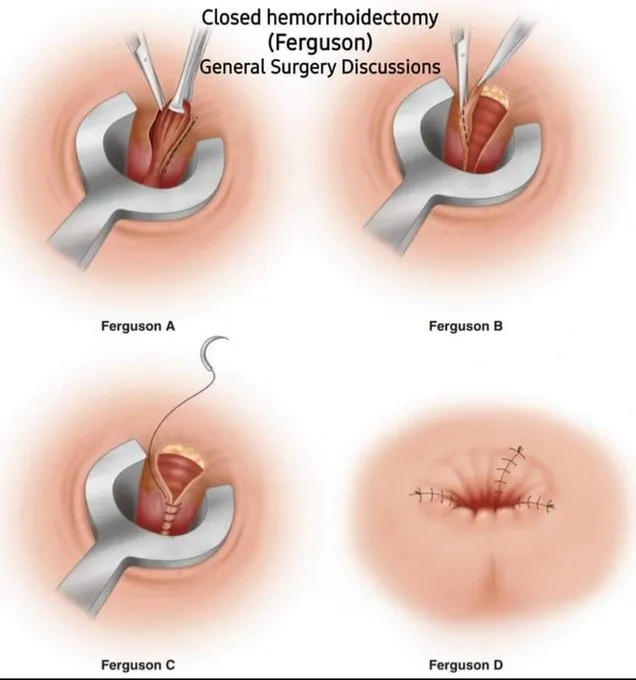
What is Hemorrhoidectomy (Closed Ferguson Technique)?
The Closed Ferguson Technique is a surgical procedure in which hemorrhoidal tissue is excised, and the wound is closed with sutures. This technique is considered less painful and offers a faster recovery time than open hemorrhoidectomy procedures. It is typically performed under local or general anesthesia, and the patient is monitored for a short period post-surgery before being sent home.
When is Hemorrhoidectomy Recommended?
Hemorrhoidectomy using the Closed Ferguson technique is recommended when hemorrhoids are:
- Large and prolapsed (protruding outside the anus)
- Painful and do not respond to non-surgical treatments (such as diet changes, medication, or rubber band ligation)
- Causing complications like chronic bleeding, thrombosis (clotting), or prolapse
Pros of Hemorrhoidectomy (Closed Ferguson Technique)
- Effective and Permanent Solution:
- The procedure removes hemorrhoidal tissue entirely, significantly reducing the risk of recurrence.
- Reduced Postoperative Pain:
- The sutured wound generally causes less pain compared to open techniques, making the recovery phase more comfortable.
- Faster Recovery:
- Because the wound is closed, the healing process tends to be faster compared to open hemorrhoidectomy.
- Minimal Bleeding:
- The use of sutures in the closed technique reduces postoperative bleeding, leading to a more controlled healing process.
- Suitable for Severe Cases:
- This technique is highly effective for treating advanced-stage hemorrhoids that have not responded to other treatments.
- Improved Quality of Life:
- The procedure offers long-term relief from painful symptoms such as bleeding, itching, and prolapse, enabling patients to return to their normal routine.
Cons of Hemorrhoidectomy (Closed Ferguson Technique)
- Surgical Risks:
- As with any surgery, there are inherent risks such as infection, bleeding, or anesthesia complications.
- Postoperative Discomfort:
- Although less painful than open techniques, some patients may still experience mild discomfort or pain during recovery.
- Potential for Scarring:
- The sutures may result in minor scarring, although this is typically internal and not visible to the patient.
- Longer Surgery Duration:
- The closed technique may take slightly longer to perform than open hemorrhoidectomy due to the suturing process.
- Risk of Constipation:
- Post-surgical constipation is a common issue, and patients may require dietary changes, stool softeners, and pain management to avoid complications.
- Not Suitable for All Patients:
- Some patients with underlying health conditions or severe infections may not be ideal candidates for this surgery.
Postoperative Care and Recovery
Post-surgery, patients are usually advised to:
- Rest and avoid heavy physical activity for a few weeks.
- Increase fluid and fiber intake to avoid constipation.
- Apply prescribed topical ointments to reduce discomfort and promote healing.
- Follow up with their healthcare provider to monitor recovery and address any complications.
Conclusion
The Closed Ferguson Hemorrhoidectomy offers a safe, effective, and minimally painful solution for patients with severe hemorrhoids. Although there are some risks and limitations, the benefits far outweigh them for most patients. At Sukhayu Hospital, we prioritize patient comfort, safety, and optimal recovery. Our experienced surgical team ensures that every patient receives the best care before, during, and after the procedure.
If you’re suffering from severe hemorrhoids and are considering surgery, the Closed Ferguson Hemorrhoidectomy may be the right option for you. Contact us at 7420004242 to schedule a consultation or learn more about this life-changing procedure.
Keywords