Doppler-Guided Hemorrhoidal Artery Ligation (DG-HAL)
An Advanced, Minimally Invasive Solution for Hemorrhoids
Doppler-Guided Hemorrhoidal Artery Ligation (DG-HAL) is an advanced, minimally invasive surgical technique used to treat internal hemorrhoids. At Sukhayu Hospital, located in Canada Corner, Nasik, Maharashtra, we offer this innovative procedure for patients who suffer from moderate to severe hemorrhoids and want a quicker recovery with minimal discomfort.
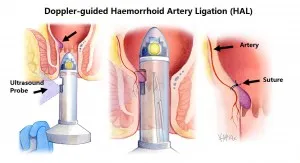
DG-HAL focuses on ligating (tying off) the blood vessels that supply the hemorrhoids, reducing their size and symptoms. This technique is based on the use of Doppler ultrasound technology to precisely locate the arteries responsible for the hemorrhoidal tissue.
What is Doppler-Guided Hemorrhoidal Artery Ligation (DG-HAL)?
DG-HAL is a procedure that uses Doppler ultrasound to identify and ligate the hemorrhoidal arteries responsible for supplying blood to the hemorrhoidal tissue. By cutting off the blood supply to the hemorrhoids, they shrink, and the symptoms such as pain, bleeding, and prolapse are significantly reduced. Unlike traditional hemorrhoid surgery, DG-HAL does not involve excising any tissue, making it a more gentle approach for the patient.
When is Doppler-Guided Hemorrhoidal Artery Ligation Recommended?
DG-HAL is particularly effective for patients who have:
- Grade II or III Hemorrhoids: Prolapsed internal hemorrhoids that do not require removal.
- Bleeding Hemorrhoids: Hemorrhoids that cause persistent bleeding, even after conservative treatments.
- Chronic Pain: Hemorrhoids that result in chronic discomfort or pain.
- Failed Conservative Treatments: When treatments such as rubber band ligation, sclerotherapy, or lifestyle changes have not been effective.
Pros of Doppler-Guided Hemorrhoidal Artery Ligation (DG-HAL)
- Minimally Invasive:
- The procedure involves no incisions, cuts, or excision of tissue. The use of Doppler ultrasound to locate the arteries allows the surgeon to ligate the vessels with precision.
- Minimal Pain:
- Since no tissue is removed, patients typically experience less postoperative pain compared to traditional hemorrhoidectomy.
- Faster Recovery:
- Most patients are able to return to their daily activities within a short period, often within a few days, as there is no major tissue removal.
- Reduced Risk of Infection:
- With no open wounds or incisions, there is a lower risk of infection compared to more invasive hemorrhoid surgeries.
- Preservation of Tissue:
- The procedure aims to preserve the surrounding healthy tissue while specifically targeting the blood vessels supplying the hemorrhoids.
- No Need for Stitches:
- The ligation of arteries does not require stitches or any invasive closure techniques, making the recovery process smoother.
Cons of Doppler-Guided Hemorrhoidal Artery Ligation (DG-HAL)
- Not Suitable for All Types of Hemorrhoids:
- DG-HAL is mainly effective for internal hemorrhoids. External hemorrhoids or more severe cases may require a different surgical approach.
- Possibility of Recurrence:
- While the procedure is highly effective for many patients, hemorrhoids may recur over time, especially if lifestyle factors are not addressed.
- Limited Effectiveness for Advanced Stages:
- In cases of Grade IV hemorrhoids or more advanced prolapse, this technique may not provide sufficient relief.
- Risk of Complications:
- Although complications are rare, there may still be a risk of incomplete ligation, bleeding, or pain if the arteries are not adequately ligated.
- Temporary Discomfort:
- Some patients may experience temporary discomfort, bloating, or a feeling of fullness in the rectum after the procedure.
- Not a Cure for Lifestyle Factors:
- While effective in treating hemorrhoids, DG-HAL does not address the underlying lifestyle factors, such as constipation or prolonged sitting, that contribute to the condition. Long-term prevention requires lifestyle modification.
Postoperative Care and Recovery
After undergoing DG-HAL, patients should follow these guidelines for optimal recovery:
- Rest: Rest for the first 24-48 hours post-surgery, avoiding strenuous activities or heavy lifting.
- Dietary Modifications: Increase fiber intake and drink plenty of fluids to prevent constipation.
- Pain Management: Mild discomfort or a feeling of fullness can be managed with over-the-counter pain medications or as prescribed by the doctor.
- Follow-up Visits: Regular follow-up appointments are essential to monitor healing and ensure the procedure was successful.
- Avoid Straining: It is important to avoid straining during bowel movements to ensure proper healing of the ligated arteries.
Conclusion
Doppler-Guided Hemorrhoidal Artery Ligation (DG-HAL) is an advanced, minimally invasive technique that offers significant benefits for patients suffering from moderate to severe internal hemorrhoids. With minimal pain, faster recovery, and a lower risk of complications, DG-HAL has become a preferred option for many individuals who want effective treatment with less downtime.
At Sukhayu Hospital, our experienced surgical team specializes in providing personalized care for patients with hemorrhoidal issues. We use DG-HAL to ensure a safe and effective treatment plan that addresses both the symptoms and underlying causes of hemorrhoids.
If you are suffering from hemorrhoids and want to explore Doppler-Guided Hemorrhoidal Artery Ligation (DG-HAL) as a treatment option, contact us today at 7420004242 for a consultation.
Keywords