Chivate’s Mucopexy Surgery for Hemorrhoids: A Comprehensive Guide for Doctors and Surgeons
Chivate’s Mucopexy Surgery is a specialized technique for the management of hemorrhoids, focusing on addressing prolapsed hemorrhoidal tissue while minimizing postoperative complications and ensuring optimal patient outcomes. This article provides a detailed guide for doctors and surgeons, including indications, contraindications, preoperative preparation, surgical steps, postoperative care, and a discussion of the advantages and limitations of this procedure.
Indications
Chivate’s Mucopexy is indicated for:
- Grade II and III Hemorrhoids: Particularly those associated with prolapse.
- Patients Seeking Minimally Invasive Options: Who wish to avoid the extensive tissue removal associated with traditional hemorrhoidectomy.
- Symptomatic Hemorrhoids: Causing bleeding, pain, or discomfort.
Contraindications
This procedure may not be suitable for:
- Grade IV Hemorrhoids: Where irreducible prolapse may require alternative surgical approaches.
- Patients with Coagulopathies: Or those on anticoagulant therapy without proper management.
- Severe Rectal Pathologies: Such as Crohn’s disease or rectal cancer.
Preoperative Preparation
- Patient Evaluation: Thorough history taking and physical examination, including anoscopy or proctoscopy, to assess the extent of hemorrhoidal disease.
- Bowel Preparation: Patients are advised to undergo bowel cleansing the day before surgery.
- Informed Consent: Detailed discussion of the procedure, risks, benefits, and alternatives.
- Prophylactic Antibiotics: Administered as per institutional guidelines.
- Positioning: The patient is placed in the lithotomy or prone jackknife position.
Surgical Steps
1. Anesthesia
- Regional or local anesthesia with sedation is preferred for better patient comfort and reduced recovery time.
2. Exposure
- The anal canal is exposed using an anal retractor for optimal visualization of hemorrhoidal tissue.
3. Identification of Prolapsed Tissue
- The prolapsed mucosa and hemorrhoidal tissue are identified.
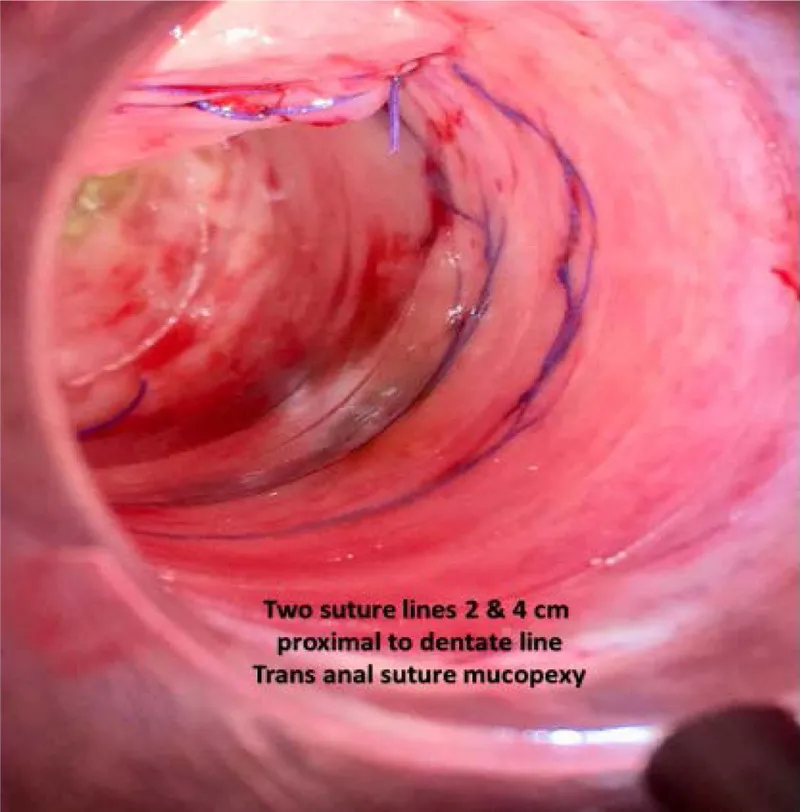
4. Mucopexy Technique
The mucopexy technique involves the precise repositioning and fixation of prolapsed hemorrhoidal mucosa, ensuring functional and structural integrity of the anal canal. This procedure requires meticulous handling and suturing to achieve the desired outcomes.
- Initial Positioning of Tissue:
- The prolapsed mucosa is gently manipulated back into its anatomical position.
- Special care is taken to avoid excessive force, which may traumatize the tissue.
- Suture Selection:
- Absorbable sutures such as Vicryl 2-0 are chosen for their tensile strength and biocompatibility.
- These sutures minimize the risk of long-term irritation and promote healing.
- Placement of Sutures:
- Sutures are placed at the mucosal and submucosal levels.
- A specific interlocking suture pattern is employed, incorporating two locking passes of the suture at each critical anchor point to enhance stability and reduce the risk of slippage. This ensures the prolapsed mucosa is securely repositioned.
- A specific interlocking suture pattern is employed to evenly distribute tension across the lifted mucosa. This technique involves passing the needle in a way that each loop of the suture overlaps the previous one, creating a reinforced anchor.
- Overlapping Suture Fashion:
- Overlapping sutures are used to enhance the structural stability of the lift.
- The technique includes a double-locking mechanism at the start and end of the suture line to further ensure robust fixation. This provides additional strength, ensuring long-term stability of the lifted tissue. This technique involves overlapping the edges of the tissue slightly to prevent gaps and ensure continuous support.
- Sutures are carefully tightened to secure the mucosa without causing ischemia or undue pressure.
- Verification of Suture Integrity:
- The surgeon inspects each suture to confirm proper anchoring and alignment.
- Ensuring uniformity and avoiding any loose ends reduces the likelihood of prolapse recurrence.
- Final Adjustments:
- After suturing, the lifted mucosa is assessed for adequate repositioning.
- Additional sutures are placed if any areas appear inadequately supported or at risk of prolapse.
This detailed suturing approach ensures the longevity of the procedure and minimizes postoperative complications, such as suture slippage or tissue ischemia. The prolapsed mucosa is lifted using sutures placed at the mucosal and submucosal levels.
- Absorbable sutures (e.g., Vicryl 2-0) are used to anchor the mucosa to the underlying muscularis layer.
- Sutures are placed in an interlocking and overlapping fashion, ensuring that the tension is evenly distributed along the lifted tissue. This technique provides additional strength and prevents suture slippage.
- Care is taken to avoid over-tightening, which may lead to ischemia.
5. Hemostasis
- Ensuring meticulous hemostasis is critical to avoid postoperative bleeding.
6. Wound Management
- The area is inspected for proper suture placement and hemostasis.
- Antibiotic ointment or gel is applied to reduce infection risk.
Postoperative Care
- Pain Management: NSAIDs or mild analgesics are preferred.
- Dietary Advice: High-fiber diet and adequate hydration to prevent constipation.
- Laxatives: As required, to ensure smooth bowel movements.
- Follow-up: Scheduled for 1-2 weeks post-surgery to assess healing and address complications.
Advantages
- Minimally Invasive: Preserves anal sphincter function and minimizes tissue removal.
- Reduced Postoperative Pain: Compared to traditional hemorrhoidectomy.
- Quick Recovery: Shorter hospital stays and faster return to daily activities.
Disadvantages
- Limited Applicability: Not suitable for severe or Grade IV hemorrhoids.
- Technical Expertise Required: Surgeons must be skilled in anorectal procedures.
- Recurrence Risk: In some cases, if prolapse or symptoms persist.
Do’s and Don’ts
Do’s
- Ensure adequate visualization of hemorrhoidal tissue.
- Maintain proper tension in sutures to avoid ischemia or loosening.
- Provide clear postoperative instructions to the patient.
Don’ts
- Avoid over-tightening sutures, as it may lead to tissue necrosis.
- Do not ignore patient’s complaints of severe pain, as it may indicate complications.
- Avoid performing the surgery in patients with unaddressed contraindications.
Potential Complications
- Bleeding: Due to inadequate hemostasis.
- Infection: Rare but possible without proper wound care.
- Prolapse Recurrence: If sutures fail or tissue is inadequately lifted.
Conclusion
Chivate’s Mucopexy is a promising approach for the surgical management of hemorrhoids, offering a minimally invasive alternative with excellent outcomes when performed correctly. Surgeons must adhere to the outlined steps and precautions to ensure optimal results and patient satisfaction.
Keywords